
By Patrick Walsh · Holy Hammer Home Services · · Updated
Quick answer: A leaking skylight does not automatically need to be replaced. The problem may be at exposed fasteners, the flashing around the unit, or a seal around the lens. The right repair starts with identifying where water is entering and checking the condition and design of the skylight itself.
When I inspect a leaking skylight in the Houston area, I want to find the failed detail before recommending a solution. A leak around the opening can make a homeowner assume the entire skylight is bad, but that is not always what I find.
Some of the problems I commonly encounter can be repaired without replacing the whole unit. Others require replacement parts or a new skylight. The difference comes from an inspection, not from the fact that there is a stain on the ceiling.
Where do skylight leaks commonly start?
In my experience, three areas deserve particular attention:
- The lower portion of the skylight: On installations with exposed fasteners in this area, those fastening details can be a source of water entry.
- The flashing along the sides and above the skylight: Rust, missing pieces, and incorrect installation can leave openings for water.
- The seal around the lens: On some skylight designs, a compromised perimeter seal can allow water into the assembly.
Finding water near one of these areas does not mean the solution is to coat the entire skylight. I need to determine which detail has failed and what repair is appropriate for that particular unit.
Can a leaking seal around the lens be repaired?
On a skylight designed to allow this type of service, a repair can involve removing the retaining frame, addressing the failed seal around the lens, and reinstalling the frame. That allows the actual sealing surface to be addressed instead of simply spreading a coating over the outside.
This is not a universal procedure for every skylight. The unit needs to be identified, its condition checked, and the repair matched to the manufacturer’s service instructions and compatible materials. A seal around a serviceable lens is also different from the sealed space between panes of insulated glass; resealing the outside does not rebuild a failed insulated-glass unit.
For modern VELUX units, I would not apply a generic tar-and-caulk repair. VELUX’s installation guidance explains that its deck-mounted and curb-mounted skylights use the specified seals, underlayment, and flashing system without additional installation sealants. Repairs must follow the guidance for the actual model.
What if the metal pan above the skylight is rusted?
One problem I see is a rusted pan above the skylight with a hole in it. That upper flashing detail is supposed to help manage the water coming down the roof toward the unit. When the metal has deteriorated through, the repair may require replacing the pan.
Putting roofing tar over the hole does not restore the condition of the metal underneath. I want to expose the problem, determine the extent of the deterioration, and replace the failed flashing detail where needed.
The replacement must fit the installation and work with the surrounding roofing and water-management layers. The goal is to give water a proper path around the skylight.
Why does missing step flashing cause trouble along the sides?
Along the sides, I often find flashing that was installed incorrectly or a missing piece of step flashing. Step flashing consists of individual pieces integrated with the shingle courses to direct water back onto the roof surface as it moves down the side of the skylight.
If a piece is missing or the flashing is arranged incorrectly, the side may need to be reflashed. That means accessing the affected area and correcting how the flashing and roofing fit together. Smearing material across the surface does not replace a missing piece or correct the underlying arrangement.
The Building America Solution Center’s skylight guidance likewise emphasizes integrating the flashing with the roof’s water-control layers and evaluating underlying conditions when deciding whether to repair or replace.
Why roofing tar is often a temporary answer
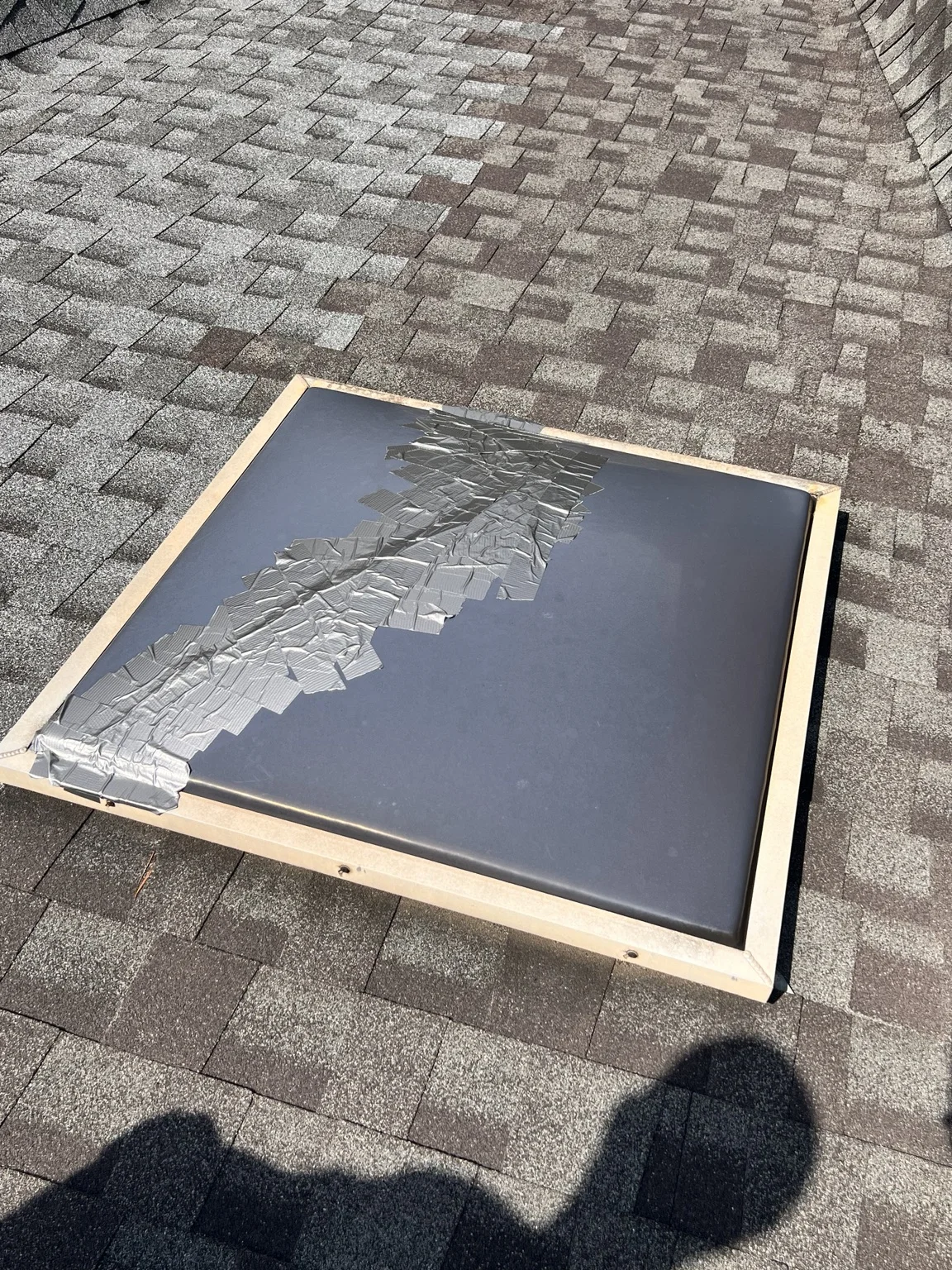
I see this all the time: someone has smeared roofing tar around the skylight instead of taking the affected assembly apart and diagnosing the problem.
In the repairs I encounter, that coating may stop the leak for a while. Over time, however, it can dry out and crack. The leak returns, and now the material covering everything makes the original problem harder to locate.
Instead of being able to see the condition of the flashing or the joint, I may first have to uncover what a previous repair concealed. A visible patch tells me that someone worked on the area; it does not tell me whether the source of the leak was corrected.
There is a difference between using a manufacturer-specified material at an appropriate detail and covering the whole assembly with roofing cement. A lasting repair depends on the diagnosis and the correct detail, not the amount of material spread around the skylight.
When does a skylight need replacement?
A cracked or broken lens is a different problem from a flashing leak or a serviceable perimeter seal. It requires evaluating replacement of the damaged glazing or the unit, depending on the model, available parts, and condition of the rest of the assembly. A coating over broken glazing is not a sound permanent repair.
Cracked glazing is not the only reason replacement may make sense. The inspection also needs to consider deterioration of the frame or curb, the unit’s overall condition, and whether suitable replacement parts are available. If the existing unit is sound and the defect is in the surrounding flashing, repairing that detail may be the appropriate option.
I want to be able to explain which part has failed and why a repair or replacement addresses it. The recommendation should follow the condition of the skylight.
Could the moisture be condensation instead?
Not every drop on a skylight comes through the roof. Condensation can form when moist indoor air meets a cooler glass surface. VELUX’s maintenance guidance distinguishes this from a skylight defect.
Tell your inspector whether the moisture appears during rain, after certain weather conditions, or even when it has not rained. That information helps guide the investigation. Timing is a useful clue, but the source still needs to be confirmed before choosing a repair.
What should you ask during a skylight inspection?
- Where is the water entering, and can you show me the problem?
- Is the issue with the skylight, its flashing, or the surrounding roof?
- Is an upper pan rusted through, or is side flashing missing or installed incorrectly?
- Does this model allow the proposed seal repair?
- Will the work correct the failed detail or only cover it temporarily?
- If replacement is recommended, what condition makes repair unsuitable?
Take photos of interior staining and note when the leak appears. Leave roof access and skylight disassembly to someone equipped to inspect and service the unit safely.
Start with the source of the leak
A skylight leak deserves a closer look before anyone recommends a new unit or another layer of tar. My approach is to identify the problem, explain what I find, and recommend work that addresses the source.
Holy Hammer Home Services is a VELUX Certified Installer serving Greater Houston. Visit our skylight service page or contact me to arrange an evaluation. For more about tracing water entry, read our guide to diagnosing a ceiling stain and roof leak.
Patrick Walsh
Holy Hammer Home Services
No Pressure. Just Solutions.